
• Home
  • Creative Results Management Blog
<< First  < Prev   1   2   Next >  Last >> 
  • 01 Apr 2026 10:26 AM | Keith Webb (Administrator)

    Just as counseling doesn't own emotions, spiritual direction doesn't own discernment.

    A reader asked me last month: If coaching is about discernment, how is it different from spiritual direction? It's a great question, and that one line is my short answer.

    As a Christian, I could say the same about consulting, teaching, or mentoring. Coaches want to help a person solve a problem or reach a goal, but there's always God's view overlapping everything. The client may not want to discuss that. But in my mind, I'm always wondering: What is God doing in this person, this situation, this organization?

    I believe that when we quiet down, reflect deeply, and go inward, a person will better hear God's nudges, whether they are Christian or not.

    So what is the difference between coaching and spiritual direction? Usually it's the focus. Spiritual direction, as I've seen it practiced, focuses specifically on what God is communicating to a person, often about their spiritual connection with Him, using tools like Scripture, prayer, and structured reflection.

    Coaching covers a wider range. But the Holy Spirit doesn't limit Himself to "spiritual" conversations. He is nudging and speaking throughout the day, including in the middle of a challenging situation, which describes most coaching conversations. God doesn't have "His one way" for every decision we face. Often He leaves us with many acceptable options to choose from. But learning to tune in to Him in our daily decisions is ripe for spiritual formation, character formation, and leader formation all at once.

    So regardless of whether I'd call a conversation coaching, mentoring, spiritual direction, or something else, I'm holding the same question underneath: What might God be doing here, and how can I align with His work?

    That's what makes every coaching conversation potentially sacred space discernment.

    Grace & Peace,

    Keith Webb

    PS - If you want to bring this kind of Spirit-attentive coaching into your leadership conversations, our training is designed to do just that.

  • 13 Feb 2026 10:21 AM | Keith Webb (Administrator)

    I'm growth-oriented. "Better and more" are always on my mind:

    • How could I connect better with people so they feel more cared for?
    • What would improve our courses for greater participant impact?
    • How could I eat and exercise differently to feel better?

    Better and more can be good things. But working toward them can become wearying hustle, endless striving, and result-preoccupation. (The opposite is also problematic: too little attention to growth or living out your calling's accomplishment dimension.)

    In the gospels, Jesus teaches and lives out "better and more" through teaching, healing, and traveling, yet without hustle, striving, or result-obsession. Jesus' approach is "less is more":

    • He frequently withdraws from crowds to pray.
    • He focuses primarily on the Twelve, sometimes just Peter, James, and John.
    • He limits ministry time in places to move elsewhere.

    This isn't just balance—equal time for being and doing. It's leveraged activity and leveraged rest. (Lounging in pajamas all day isn't the same as walking and praying an hour each afternoon.)

    Jesus shows us that effectiveness isn't about maximizing activity. It's about aligning our work with the Father's. The question isn't "How much can I accomplish?" but "What is mine to do?" That shift put me in a "less is more" mindset.

    Grace & Peace,

    Keith Webb

  • 01 Dec 2025 3:45 PM | Keith Webb (Administrator)

    Which mental time zone are you living in? Some people live in the past, others in the future or the present.

    Here’s the secret, change happens in the present. The results of those changes happen in the future, but because of what you do in the present.

    The trick is to learn from the past, plan for the future, and be present today.

    Living In The Past

    Time always moves forward yet, sometimes we don't move with it. We may want to relive pleasant memories of when we were younger, happier, or at the top of our game. The past may also capture us through unhealed wounds that continue to hurt. Lack of forgiveness, offered or received, traps us in a mental time zone of the past. Christ's redemptive work frees us from the past's hold.

    Living In The Present

    It is always the present, but few live here. In the present, we're faced with my life as it is, which often doesn't measure up to what we want it to be. The present, however, is the only time zone where we can respond to God's leading and do things differently. Many divine opportunities fly by because we aren’t present for them.

    Living In The Future

    Visiting the future to explore our dreams, hopes, ideas, vision and calling is necessary to orient us to the present. However, living in the future can distract from the present. Our lack of results can be because we refuse to live in, or at least occasionally visit, the present.

    When Are You living?

    Paul models a balanced approach to time in Philippians 3. Notice how he acknowledges the past, fixes his eyes on the future prize, yet presses on in the present:

    “Not that I have already obtained all this, or have already arrived at my goal, but I press on to take hold of that for which Christ Jesus took hold of me. Brothers and sisters, I do not consider myself yet to have taken hold of it. But one thing I do: forgetting what is behind (past) and straining towards what is ahead (future), I press on (present) towards the goal to win the prize for which God has called me heavenwards in Christ Jesus" (Philippians 3:12‬-‭14‬).

    Learn from the past, plan for the future, and be present today. Results happen because of what we do in the present.

    This week, watch for which mental time zone are you most tempted to live in. How is God calling you to be present today?

    Grace & Peace,

    Keith Webb

  • 16 Nov 2025 10:29 AM | Keith Webb (Administrator)

    My "smarts" can get in the way when I'm trying to help people. After hearing their situation, I may think I know solutions or at least resources for them—an article, a book, a video.

    But it often doesn't help. People's situations are complex and messy, full of contradictions—just as mine are.

    Years ago, I realized people needed more wisdom from the Holy Spirit and less from me.

    I'm reminded of Paul's discussion of the cross and resurrection in 1 Corinthians 1:18-31 where he writes, “For the foolishness of God is wiser than human wisdom, and the weakness of God is stronger than human strength” (1‬:‭25‬).

    That teaching firmly puts me in my place!

    This is why I like coaching. Done well, coaching draws out how the Spirit may be leading a person. Through questions and reflection we explore deeply and remain open to things that don't necessarily make sense to us. Rather than focusing in on our experience and ideas, we explore what else may be going on, and what God might be doing.

    Perhaps you've felt this tension too—the pull between wanting to help and recognizing the limitations. I'm still learning, but I'm discovering that creating space for someone to hear from God is almost always more powerful than any answer I could provide.

    Grace & Peace,

    Keith Webb

  • 31 Oct 2025 8:39 AM | Keith Webb (Administrator)

    Jesus demonstrated a brilliant strategy for drawing out people's thoughts and feelings through a simple but powerful questioning sequence. We can see it in this example from Luke 9:18-20:

    "Once when Jesus was praying in private and his disciples were with him, he asked them, 'Who do the crowds say I am?' They replied, 'Some say John the Baptist; others say Elijah; and still others, that one of the prophets of long ago has come back to life.' 'But what about you?' he asked. 'Who do you say I am?' Peter answered, 'God's Messiah.'"

    Jesus has a two-step approach: he warms them up with a safe question about others before inviting them to a more personal response.

    Step 1: The Safe Warm-Up Question
    "Who do the crowds say I am?" This question creates emotional safety. When we discuss what other people think, we don't risk exposing our own thoughts or committing to a position. It's a psychological shelter—we can explore ideas with less personal risk.

    Clients often refer to "other people" without realizing it. (Did you notice? I just demonstrated it myself by writing "clients often do this" rather than "often do this." We naturally hide behind the comfort of discussing others.)

    Step 2: The Open-Up Question
    After the warm-up, people feel safer sharing their true thoughts. "But what about you? Who do you say I am?" Jesus gently but directly invites personal disclosure.

    I use Jesus' question sequence in two ways:

    1. I start with an "other people" warm-up question like "What does the team think about this goal?" Then transition to a personal question, "What about you? How do you feel about it?"
    2. When I ask a personal "you" question but receive an "other people" response, I gently ask again, "I hear what others think—but what about you? What's your take?"

    How might you use Jesus' question sequence to encourage deeper, more authentic conversations? Whether you're coaching or simply trying to connect more meaningfully with those around you, follow Jesus' example to open hearts and minds.

    Grace & Peace, 

    Keith

  • 24 Jul 2025 12:46 PM | Keith Webb (Administrator)

    A hallmark of coaching is the conversation topic always comes from the client, not the coach. We ask what the client would find important or meaningful to work on. And then we explore that topic to assist the client to make progress.

    Coaching clients are pleasantly surprised that we listen to them and value what they care about. To them, that’s helpful. That’s useful.

    Being useful is important. The Apostle Paul wrote, “Get Mark and bring him with you, because he is helpful to me in my ministry.” 2 Timothy‬ ‭4‬:‭11‬b ‭NIVUK‬‬

    As Christians, I wonder how the people around us view our usefulness and the value we add to their lives and the larger community. Remember, everyone evaluates based on what’s important to them.

    What if Christians regularly asked:

    • What do you see as the most pressing issues in our community?

    • What could our church do that would be useful to the community?

    • What value might we endeavor to add?

    I know one church who asked community leaders these questions. What they heard was a need for affordable and immediately available counselling. The church created a space, refocused a staff member, and recruited two other counsellors to meet the need. The city now refers people to them. Because they are useful.

    If “useful” is in the eye of the beholder, to know, we need to ask.

    Grace & Peace,

    Keith Webb

  • 27 Jun 2025 3:35 PM | Keith Webb (Administrator)

    Jesus could have delivered the Sermon on the Mount, said "Go and do likewise," and moved on to the next town. But He didn't.

    Instead, He walked with His disciples daily, watching them implement His teachings. When Peter failed at walking on water, Jesus coached him through it. When the disciples couldn't cast out a demon, He debriefed with them privately. When they argued about greatness, He used it as a teachable moment.

    Notice Jesus' pattern:

    • He taught principles (the parables, the sermons)
    • He created practice opportunities (sending them out two by two)
    • He debriefed their experiences ("What happened when you tried to heal that boy?")
    • He coached them through failures (Peter's denial, Thomas's doubt)

    Jesus spent three years following up His initial teaching. The result? They became people who turned the world upside down.

    Jesus spent more time coaching His disciples than teaching crowds.

    Follow Jesus' example.

  • 30 May 2025 12:27 PM | Keith Webb (Administrator)

    Years ago, Paul Rhoads, a mentor of mine, asked me when I most clearly have heard God's voice. It's in an interesting question.

    My image of when people most clearly heard God's direction is after extended times of prayer or meditating on scripture. This hasn't been my experience.

    For me, it's when I travel. 

    I could recall a time when I was alone at a Starbucks in London gazing out the window while journaling. Or at an airport watching planes taxi around during a 3-hour layover on my way home.

    Paul, inquired further, "What was it about those times that you think caused you to tune into God's voice?" Another interesting question.

    After reflecting a minute, it was that I was away from my normal place, normal rhythm, and often at the end of a busy week leading a training with a group of diverse people. The new people, new place, new culture, new ways of doing things, all caused me to be more spiritually attentive to how God was directing me.

    How would you answer Paul's two questions?

    Grace & Peace,

    Keith Webb

  • 03 Mar 2025 2:38 PM | Keith Webb (Administrator)

    Coaching skills are useful for demonstrating respect, care, and building relationships in everyday conversations, not just formal coaching conversations.

    As we're reminded, "Let your conversation be always full of grace, seasoned with salt, so that you may know how to answer everyone" (Colossians‬ ‭4‬:‭6‬).

    Here are a few examples from the past month:

    On a family outing, when we were making plans for the day, I engaged my active listening and asked a few more questions to draw out from others, rather than pushing my ideas. Happy family.

    On a call with a potential new client, I took time to acknowledge and empathize with their current situation before sharing with them how our coaching training could be part of their solution. Happy potential client.

    At a dinner party, I held back my story that I was reminded of as another person shared. Instead keeping the focus on them, I asked a follow up question that drew out more of what the person felt about what they were sharing. Happy friend.

    I'd love for these behaviors to have been perfectly natural for me. But they aren't. Only by intentionally learning and practicing coaching skills was I able to use them in the moment.

    Grace & Peace, 

    Keith Webb
  • 04 Jan 2025 11:21 AM | Keith Webb (Administrator)

    A friend's family theme for 2025 is "thrive." I like it so much I'm joining—the thrive theme, not his family. How about joining too for "Thrive in '25"?

    Here are some reflective questions to assist you to understand what "thriving" means to you, and how to approach it this year.

    Imagine...

    • What does "thrive" mean to you?
    • What would be different if you were thriving?
    Listen...
    • What stirs in you, even as you think of thriving?
    • What doubts emerge?
    Reflect...
    • What needs to shift in you to thrive?
    • What would you need to do differently?
    • Are you willing?

    Plan...

    • What habits might get in the way of thriving?
    • What are thrive-habits you could begin doing instead?
    • Who would you like to join you to Thrive in '25?

    As you might catch from the reflective questions, thriving is less about changing your circumstances and the people around you, and more about what's happening in your heart and what you do.

    Thriving doesn't just happen. You must be intentional in your thoughts and actions.

    Grace & Peace, 

    Keith Webb

<< First  < Prev   1   2   Next >  Last >> 

FROM KEITH WEBB

Keith WebbIf you're a Christian leader and want to multiply your impact, we can help. I developed The COACH Model® and our ICF-approved Christian coaching training to help you achieve organizational results while simultaneously developing people.
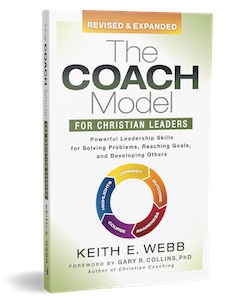
Since 2005, we have led leadership development and coaching processes in more than 30 countries with 20,000 leaders 350 organizations.

Learn more about us »

DOWNLOAD TWO CHAPTERS

CONNECT WITH US

OFFICE HOURS

We work remotely to keep rent from raising the price of our coaching training. The best way to contact us is via email. We can give you a call, if you wish.

Monday - Friday 
9am to 5pm (Pacific time)

Copyright © 2025 Creative Results Management
Privacy policy. Terms & Condition.

Powered by Wild Apricot Membership Software