Blog

Welcome to the Creative Results Management blog. These post first appear in the CRM Coaching eNews, our monthly newsletter. Subscribe here.

Log in to be able to comment. Use "Help" if you need help logging in. If you don't have a log in, contact us and we'll give you one.
<< First  < Prev   1   2   3   Next >  Last >> 
  • 07 May 2013 10:40 PM | Keith Webb (Administrator)
    There are few things more disruptive than a major illness or an international move. The good news is I've only experienced an international move. The bad news is we have moved internationally five times!

    Moves and job changes, dating and marriage, births and deaths, accidents and illnesses - actually, transitions of any sort are emotional equivalents of rough roads. Coaching helps people travel these roads.

    Let's use an international move as an example of a rough road. Here are ways to help your coaching clients.

    1. Get organized earlier than you think you need to be. Make sure you cover the essentials first. In a move, this means paying bills, taking care of financial and legal things, turning in reimbursements in so you'll be paid, etc.

    2. Prioritize your efforts. When traveling rough roads, you have less available time and attention. Cut back on non-essential activities ahead of time. Take extra time with family members to increase communication during the stress.

    3. Get help, but only from those who are helpful. Some people are better suited for joining me on a rough road. Others stress me out. I invite help from those whose help leaves me encouraged, and I politely refuse help from those who don't.

    4. Keep perspective, the rough road will come to an end. On the rough road it's easy to feel overwhelmed and lose hope. Yet, it will end. The movers will come. You will get on an airplane. You will get set up on the other end.

    5. Grieve the loss, embrace the future. Rough roads, and indeed all change, produce real loss. It's okay to be sad, or even mad. But we can't stay there. Embrace the future good and stability that will come. This may take a large degree of faith.

    6. Prepare to give grace. Everyone is easily irritated and short-tempered on rough roads. Now is not the time to confront your spouse about his or her attitude problem! Give grace to one another. Be a peacemaker by diffusing tensions.

    We don't always see a sign warning us of rough roads ahead, but when we do or when we find ourselves on a rough road, use the tips above to make it easier.

    If you can only do one, choose grace.

    Coaching Questions
    • What are the essential things you need to take care of?
    • What can you cut from your schedule so you can focus on traveling this rough road?
    • What relational or emotional things need to be processes right now? What can wait? 
    • Who can help you?
  • 08 Apr 2013 9:13 AM | Keith Webb (Administrator)
    Two people hear a news report about the President. One person scoffs, thinking the President is ruining the country. While the other person is inspired by the President's leadership on a tough issue. Same information, opposite interpretations. Why?

    We know that "the mouth speaks what the heart is full of" (Matthew 12:34), but how about "the ears hear what the heart is full of"? The fact is, we listen through the filters of our beliefs, experiences, emotions, expectations, etc.

    During a coaching conversation the coachee said, "I want to create new things, not run existing programs for other people." In a split second, the coach interpreted this to mean that the coachee isn't serious about ministry.

    How did the coach draw this conclusion? The coach believes that creating new things means just wanting to do the fun work that comes with a lot of ego strokes - "That's such a cool new vision!" - while others are left to do the hard work of implementing and getting real results. So, in an instant the coach put this interpretation to the coachee's statement.

    This is called "confirmation bias". The human mind is predisposed to take in information and interpret it in ways that confirm what we already think. And to screen out and discount information that contradicts what we think. Coaches are not exempt from confirmation bias.

    As a coach, ask yourself:
    • What other options are there to understand this?
    • How could a case be made for one of these options?
    • What evidence do I have from this coachee that any of these assumptions are correct?
    In reality, there is no time in a coaching conversation to answer these questions. The best approach is simply to be open to alternative viewpoints and ask open and clarifying questions to explore what's behind the coachee's statement.
    • What does "create new things" mean to you?
    • What happens when those things are not new anymore and develop into programs, then what?
    • What does creating new things give you personally that running existing programs doesn't?
    We listen with our brain, not just our ears. Our brain wants to sort information to confirm what it already thinks. Stay curious. Look for alternative viewpoints. Ask open questions.
  • 09 Mar 2013 5:21 PM | Keith Webb (Administrator)
    A little thanks goes a long way.

    In Luke 17, Jesus healed ten lepers and only one came back to give God thanks.

    Recently, an executive told me, "I am always willing to help someone, even more so when I know they did something with that help." All too often we accept the help and then fail to thank the person who helped us.

    We don't thank others for any number of reasons: we're too preoccupied, we figure we could have done it on own anyway, we didn't follow through on what we said we would do, we don't want to bother the person, etc.

    I train and coach hundreds of people a year, yet I'm often left wondering what impact that help had on them and their work.

    Occasionally, I receive an email from from someone letting me how they are using what they learned. I happily receive these notes (and I'm not fishing for more with this article).

    Saying "thanks" is a type of feedback. With all feedback, the more specific the better. It helps me to know what I'm doing is effective and important to others.

    Not long ago, a women wrote to tell me how her relationship with her teenage daughter had been transformed as she took more of a coaching approach. That note inspired me to lead a 8-week Sunday School class for parents of teens to explore how to integrate coaching skills into parenting.

    Showing gratitude and reporting back about how you are using what you learned does a lot for the person who helped you.

    We all need the encouragement.

    Coaching Questions (for yourself and clients)
    • What's keeping you from being more appreciative?
    • Who do you owe a "thank you" to?
    • How might you show your gratitude to this person who helped you?
  • 11 Feb 2013 9:11 AM | Keith Webb (Administrator)
    Supervisors (and parents) have authority and responsibility for other people. These two factors set supervisors apart from the role of a professional coach where the coach has neither authority nor responsibility for the coachee.

    Supervisors can always choose to be directive, and in fact, must at times. Supervisors also must take a coaching approach to empower and develop employees. Balancing these two functions is difficult. Extremes either way are not optimal.

    A supervisor who is too directive, micromanages. I remember a supervisor of mine who informed me, "I don't pay you to think, just do what I what I tell you to do." How many of us have treated our employees like this, "lording over" them rather than serving them as Jesus speaks to in Mark 10: 42-45?

    Employees, more than anything else, want to have choices in their work, to be in on decisions, and feel like they are contributing and growing. This, of course, is where supervisors who use coaching skills excel.

    Supervisors will make sure employees understand the needed outcomes, budget, decision making boundaries, and timing. Then, as much as possible and as needed, coach employees to accomplish their tasks. WWII General George S. Patton said, "Never tell people how to do things. Tell them what to do and they will surprise you with their ingenuity."

    Being directive is always an option but with downsides. As a supervisor you can use a coaching style with your employees. Here are some ideas:
    • Ask for her ideas first, before adding yours.
    • Ask if he needs help thinking through the work, rather than assuming he does and giving advice.
    • Use self-evaluation questions first, then add your feedback if necessary.
    • Encourage her to form her own action steps, rather than you assigning them.
    • Follow-up with, "What progress have you made?"
    Stepping in with authority:
    • "You have pursued this approach for two weeks now with little results. I'm concerned that it will not be done by the deadline next week."
    • "I appreciate your initiative. Your recent decision, however, goes beyond the scope of the project."
    • "Your outburst at the meeting was inappropriate and disruptive. I do not want that to happen again."
    With any of these scenarios, a coaching approach could be used to follow through in the conversation.

    The Apostle Paul speaks of "the authority which the Lord gave me for building up and not for tearing down" (2 Cor 13:10). The empowering supervisor uses his or her authority when appropriate but regularly develops capacity and skills of employees through coaching style interactions.
  • 08 Jan 2013 9:43 AM | Keith Webb (Administrator)
    I'm preparing to speak to a group of Christian executives and want to communicate why coaching skills and mindsets are so powerful. Here are seven insights:

    1. We behave our way into new thinking. Don't wait to be fully convinced, try it. Your thinking and emotions will follow your successful behaviors. Abraham's faith was made complete by his actions (James 2:22).

    2. Defining the result we want up front focuses us on what's important. You know what you want and can go after it more easily. Joshua's commitment comes to mind (Joshua 24:15).

    3. Greater perspective allows us to make better decision and see potential obstacles more clearly. Questions are the number one tool to increase perspective.

    4. Always have well-defined next steps for action. We know the limitations of good intentions. Setting action steps moves intangible reflection toward tangible results. "Do not merely listen to the word, and so deceive yourselves. Do what it says" (James 1:22).

    5. Telling others our intentions increases our commitment. We are ten times more likely to achieve our goals if we tell them to someone else. Is this why we are told to confess our sins to each other (James 5:16)?

    6. Knowing someone will ask what we did increases our chances of doing it. Follow-up action steps by asking, "What progress did you make?"

    7. We change by stopping our current undesired behavior and doing our desired behavior. All coach techniques work towards these two points, especially doing the new behavior. In Biblical terms, "stop it" and "do it" make up the meaning of "repentance".

    Coaching Questions
    • Which of these insights do you practice regularly?
    • Which do you need to begin this week?
    • Set one goal today along with next steps and ask someone to ask you about your progress next week.
  • 06 Dec 2012 9:00 AM | Keith Webb (Administrator)
    How you are 'right' is more important than being 'right'.

    Early in my marriage, my wife and I were arguing about something. We each thought we were right. I was right. Finally, after a bit of a verbal battle, I won. She reluctantly admitted that I was right. Victory!

    But I still slept on the sofa that night. This is when I learned the difference between "being right" and "how I am right".

    "Being right" is a matter of facts. It's the right answer, statistic, or information. It can be fact-checked on the Internet. Facts are cold and emotion-less.

    "How I am right" is a matter of opinion. It's about the social interaction that takes place during the conversation (or argument). It's about the tone of voice, body language and attitudes I demonstrate. These things generate a lot of emotions.

    I'm reminded of Philippians 2, "Do nothing from selfishness or empty conceit, but with humility of mind regard one another as more important than yourselves; do not merely look out for your own personal interests, but also for the interests of others. Have this attitude in yourselves which was also in Christ Jesus..."

    How will I be right in humility? With kindness? With respect?

    As you coach others, help them explore how they were right and what that may have communicated to the other person. The emotions are all in the "how" of being right.
  • 07 Nov 2012 2:29 PM | Keith Webb (Administrator)
    It started as a kitchen remodel. Since we are changing the kitchen we might as well do the dining room. And while we're at it, the living room. And since the construction guys are already here we should remove all the old intercom boxes from every room. Before we knew it our kitchen remodel became a house remodel!

    This is called "scope creep". It's the expansion of the original plans to include more and more objectives. It's natural, since everything is connected to everything else. Drawing a line somewhere to limit objectives seems arbitrary at times, but it must be done.

    In coaching, we can experience scope creep in a couple of significant ways.

    The Client's Objective
    As you work with the client on their objective(s), the topic continually grows to include additional issues and other related goals. The inclusion of many related issues does not allow the client to focus and gain traction on a particular objective. The client (and coach) can become stuck in a tangled mess that becomes more tangled as you go.

    Have the client list the main issues or objectives. Then sort by which are foundational, the ones the others build on. Begin by isolating and working on the foundational issue(s) looking for insights and a few options first. Then have the client "try out" her thinking by expanding the discussion to the other related issues one at a time.

    The Coaching Agreement
    Perhaps you set up a twice a month coaching call with a client. As you meet with him, you realize he needs additional help that you have the expertise to provide. So you send some articles. Which generates a few clarifying phone calls from the client. And now the client's team wants to have a call with you that the client says you can do in place of your normal coaching call. This is scope creep. You are no longer coaching the client, the work has expanded to an on-call consulting relationship with the whole team.

    Go back to the original coaching agreement and discuss it with the client. Express your desire to complete that agreement as it stands. You would be happy to set up another agreement to simultaneously consult with the client's team. In this way you are best able to serve the needs of the client.

    Our house remodel is coming to a close. The kitchen looks great and so does the rest of the house. Next time, however, we'll focus one room at a time.
  • 10 Oct 2012 9:44 AM | Keith Webb (Administrator)
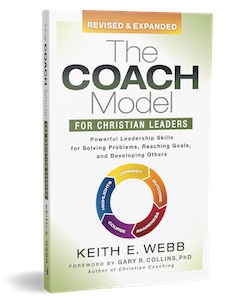
    The five steps of the COACH Model™ will guide you through empowering, holistic conversations. Each step of the COACH Model™ can also be used separately in daily conversations.

    Coaching skills are useful with everyone we meet, no matter if we have three minutes or an hour.

    Here are a few ideas:

    Connect. Build rapport and trust.
    Ask, "How are you?" and really listen. People love to talk and feel valued when you pay attention to them.

    Outcome. Find the other person's agenda.
    Ask your spouse, "What do you want to make sure we do this weekend?" Ask an employee, "What would be helpful for us to talk about?"

    Awareness. Encourage discovery and shifts in perspective.
    When someone tells you about an experience, ask, "What did you learn from doing that?" At the dinner table ask, "What is one thing you didn't realize before today?"

    Course. Put insights into 2-3 actionable steps.
    Ask your child, "What's the next step you need to take to complete that project?" Finish a meeting by asking, "What actions are each of us willing to commit to complete before our next meeting?"

    Highlights. Review the conversation.
    On the way home from church, ask, "What do you want to remember from today?" As you finish reading something ask yourself, "What was most useful from this article?"

    Coaching skills can be used in any situation, one skill at a time. Don't wait until you have time or the situation to put them all together into a long conversation.
  • 11 Sep 2012 9:43 AM | Keith Webb (Administrator)
    Instruction and coaching speed up the learning process. The balance between these two leadership activities will change as the other person becomes more competent.

    Think of helping a teenager to learn to drive a car, something that is happening in my home right now. As my 15 year-old son began driving not only did he take a driver's education class, but I also instructed him step-by-step as he drove.

    In the beginning, I used very little coaching. When your teen is about to drive through a red light, it's just not appropriate to ask a reflective coaching question, like, "What meaning does a red traffic light have for you?" A more direct, instructional approach such as, "That light is red" or "Stop!" better fits the situation and skill level.

    As the new driver develops skills, the instruction should go down and the coaching should go up. Yet, it's easy for parents to continue to instruct their teenager step-by-step as if it's those first couple of months driving.

    Instruction, when it's not needed or wanted is perceived as nagging, and resented. At work, instructing when we should be coaching is called micro-managing.

    Go with as much instruction as is needed and coach the rest of the way.

    Coaching Questions
    • What help do you need from me?
    • Are you open to some input on how to do this?
    • Given what you know about this task, how are you thinking of approaching it?
  • 06 Aug 2012 9:00 AM | Keith Webb (Administrator)
    Leaders are often propelled forward or held back based on their mastery of "soft" skills. Soft skills, like self-awareness, resilience, interpersonal communication, conflict resolution, and selling skills, are fuzzy and change with the situation. Making them more challenging to learn than "hard" or technical skills.

    Soft skills are not new, they used to be called character. Things like honesty, trustworthiness, patience, courtesy, self-control, perseverance, and resilience. The ways we treat others, like showing kindness, compassion, grace, humility, and generosity. These are all soft skills and character traits that the Bible extols (I Peter 3:8-9, 2 Peter 1:5-9).

    As I coach leaders, they rarely need coaching about their technical expertise. More commonly, I coach on soft skills. Competency in technical skills is not often accompanied by competency in a wide range of soft skills. This is one reason that highly skilled teachers, accountants, or engineers can make terrible managers of others.

    Soft skills can't be learned in school, except perhaps the school of life. Here are three soft skills everyone needs and a few questions to stimulate your thinking.

    Self-Awareness
    Knowing your motivations, drives, hot buttons, and links to your emotions. Knowing these can help you better control your responses.
    • What motivates or demotivates me?
    • What things arouse anger or frustration in me?
    Interpersonal Communication
    The ability to communicate in such a way that your intended meaning comes across to others. This is tougher than it sounds!
    • To what extent have I listened to and understood others first?
    • How do I need to adjust my tone, posture, words, timing, or message to be better understood?
    Team Skills
    The ability to work with people with different skills, motivations, and personalities. This is the culmination of soft skills, and why real teamwork is so elusive.
    • Reflect on Philippians 2:1-4 in light of your team.
    • In what ways am I perceived by others? Am I see as honest, trustworthy, courteous, and hard-working?
    • How do I treat others? Am I accepting, gracious, honoring, kind, loving, and thinking of others before myself?
    Given how critical soft skills are, what are you going to do to grow in them? How about coaching others in them?
<< First  < Prev   1   2   3   Next >  Last >> 
 

Creative Results Management
Subscribe to the CRM Coaching eNews, our monthly newsletter.
Office hours: Monday - Thursday 9am to 5pm (Pacific time)
© 2012 Creative Results Management. All Rights Reserved. Contact Us

Powered by Wild Apricot Membership Software